
Water Heater Repair
Not sure the tank is done? A tested diagnosis first — many no-hot-water calls end as a single-part repair.
Water Heater Replacement — Pocatello, ID
When a tank is leaking, rusting, or living on borrowed time, we connect you with independent local plumbers who size the new unit to your household and swap it on your schedule — not during a flood.
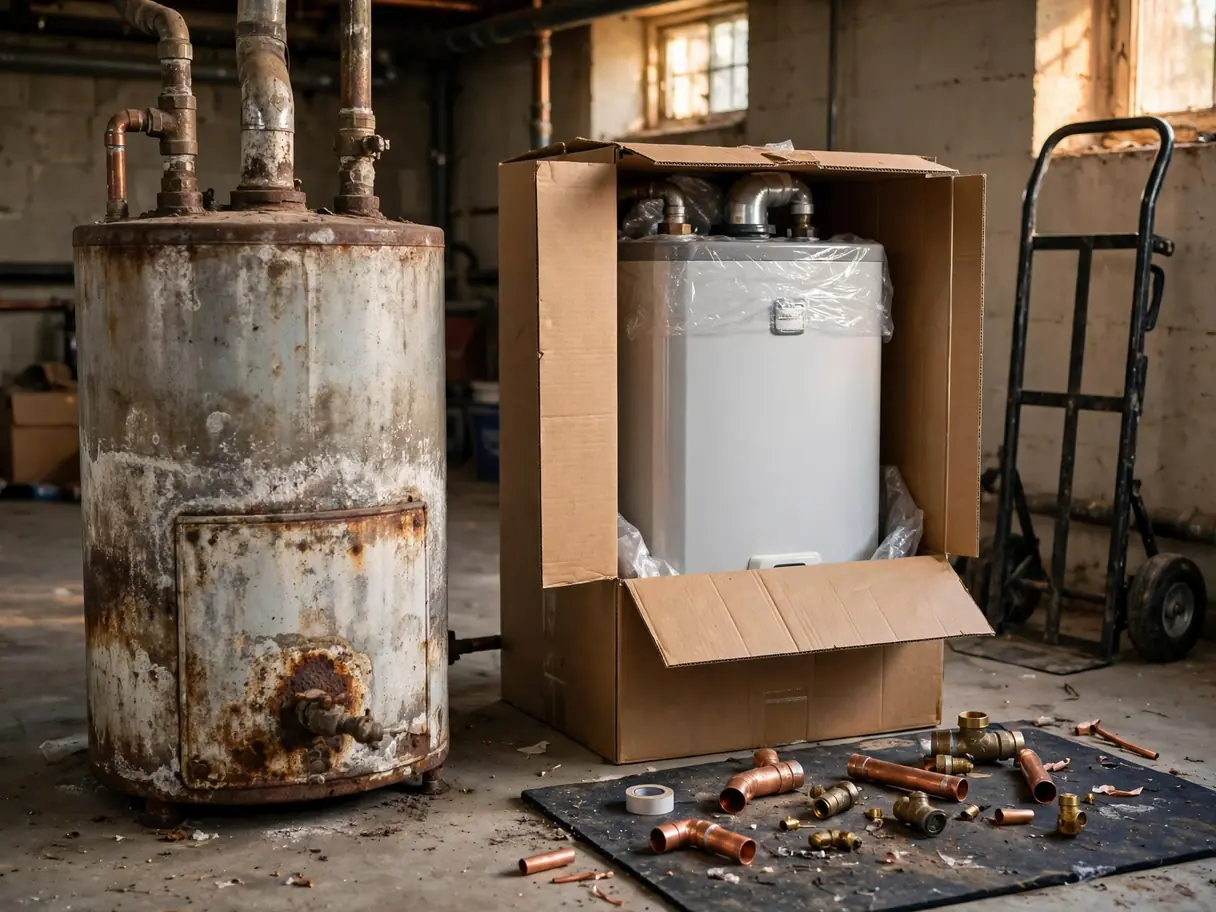
Every water heater in Pocatello is in a slow fight with the water itself. At about 15.2 grains per gallon in the city supply — very hard water — mineral scale coats the inside of the tank, the anode rod gets eaten away years ahead of schedule, and corrosion starts on the steel. That is why tanks here often give out sooner than the national averages suggest, and why replacement is the most common water heater job we connect homeowners with.
The signs are usually plain once you know them. Water pooling under the tank or dampness that keeps coming back. Hot water that runs rusty, especially first thing in the morning. Rumbling that has gotten louder over a year or two. Hot water that runs out faster than it used to, in a house that has not changed. And plain age: if the label on your tank says it is ten years old or more, it has done its work. If the heater is still running but showing two or three of these, start with the signs a water heater is failing and plan the replacement while you still get to choose the day.
A replacement is the one chance you get each decade to fix a sizing mistake. A tank that was too small has annoyed your household for years; a tank that was too big has been heating water nobody uses. The plumber counts the household, the bathrooms, and the busiest hour of the day — showers, laundry, and the dishwasher overlapping — and matches the new unit to that peak, with the right first-hour rating for a Pocatello winter, when incoming water is cold and every tank works harder.
Fuel is the other fork in the road. Most homes replace like with like, gas for gas or electric for electric, because the connections are already there. But a replacement visit is also the honest moment to ask about tankless water heaters — no tank for hard water to fill with sediment, hot water that does not run out, and a unit that hangs on the wall instead of standing in the corner. It is a conversion with real added work, and a good plumber will tell you when it does not pencil out. Brands handled include Rheem, Bradford White, and A.O. Smith for tank models, and Navien, Rinnai, and Noritz for tankless — the plumber fits the unit to your home rather than pushing one name.
Putting a new tank on the same hard water that killed the old one repeats the story on a shorter clock. This is the right time to talk about water softeners, which strip the minerals before they reach the heater, and about a simple annual flush habit that keeps sediment from building up in the first place. Neither is required, and neither should be sold as magic — but in this city, softened water is the single biggest thing that decides whether a tank dies at year seven or year twelve.
The old tank is drained and hauled out. The new unit is set, leveled, and connected — water lines, gas or electrical, venting — with new valves and an expansion tank where the system calls for one, and a drain pan under it if the location needs one. Then the plumber fills the tank, purges the air, fires it up, and checks it through a full heating cycle, including the relief valve and every new joint for leaks. The full scope of a standard water heater installation is covered on that page.
There are two ways to meet a water heater replacement: as an appointment or as an emergency. The appointment version looks like this page — a sizing conversation, a choice between tank and tankless made with both prices in hand, a morning set aside, and a household that showers at the new unit that evening. The emergency version starts with water on the floor and takes whichever unit can be installed that day. The tanks that get replaced on schedule are the ones whose owners acted on the early signs: the growing rumble, the first rust, the label's date doing quiet math in the background. If your tank is showing two of those, the time to have this conversation is while it is still a conversation.
Replacements come up everywhere we serve, but the pattern differs by neighborhood. The older housing around the University District and Indian Hills holds more tanks at or past the age where failure becomes likely, while newer homes in Chubbuck are hitting the first replacement cycle on builder-installed units. Either way, call (208) 753-1090, describe the tank you have, and we will match you with an independent local plumber who quotes the whole job at your home — unit, labor, and haul-away — before any work begins. If the old tank is actively leaking onto the floor right now, say so: that is emergency plumbing, and it gets routed first.
FAQ
The clearest signs are water leaking from the tank body itself, rust coming out of the hot taps, a tank that rumbles loudly and has for a long time, and age — manufacturers quote ten to twelve years for most tank heaters in average water, and Pocatello's hard water tends to shorten that, so eight or nine years is common here. Repeat repairs in the same year are another sign. A plumber can confirm it at the unit, but a leaking tank is not a repair conversation.
A straightforward like-for-like swap — same size, same fuel, same spot — is usually a half-day job: drain and remove the old tank, set and connect the new one, fill it, and check it through a full heating cycle. The job runs longer when the new unit needs different venting, a moved gas line, an expansion tank added, or a bigger electrical circuit. Your plumber will tell you the expected timeline before starting.
Size follows your household's busiest hour, not just the number of bathrooms. A plumber counts the people in the home, how many showers run at once, and whether a soaking tub or a high-flow fixture is in the mix, then matches that to the tank size and its first-hour rating. Going bigger than you need wastes fuel keeping water hot. Going smaller means the last shower runs cold.
Replacement cost is driven by the unit itself — tank size, gas or electric, standard or high-efficiency — and by the work around it: venting changes, gas line or circuit changes, an expansion tank, a drain pan, and hauling the old unit out. Access matters too, whether the heater stands in an open garage or a tight basement corner. The plumber measures your setup and quotes the full job in your home before any work begins.
Often, yes — but it is a conversion, not a swap. A tankless unit needs a larger gas supply or a heavier electrical service than most tank heaters, plus different venting and, in Pocatello, a plan for hard water, since scale builds up inside a tankless heat exchanger too. A plumber sizes the unit to your peak demand and tells you plainly whether the conversion makes sense in your home.
If the signs are stacking up — age past ten years, rust in the hot water, a rumble that has grown, a repair already done this year — replacing on your schedule is almost always the calmer and cheaper path. A planned replacement lets you choose the unit, compare tank and tankless with real numbers, and schedule the work on a weekday. A failed tank chooses all of that for you, usually on the worst day available.
The old unit is drained, disconnected, and hauled out as part of the replacement job — you should not be left with a dead tank sitting in your basement or garage. Before it goes, the plumber transfers nothing you need to keep; the new unit gets its own valves, connectors, and safety devices as part of a proper install.
Plan the swap before the old tank decides for you. One call connects you with an independent local plumber serving Pocatello and Chubbuck.